
How to Calculate a Tip: The Simple Formula (With Examples)
To calculate a tip, multiply the bill by the tip percent as a decimal. On a $60 check, a 20% tip is $60 x 0.20, which is $12, and the total is $72. Use 20% for good service, 18% for standard service, and 15% when the service was only adequate. The same formula works on any check, at any percent.
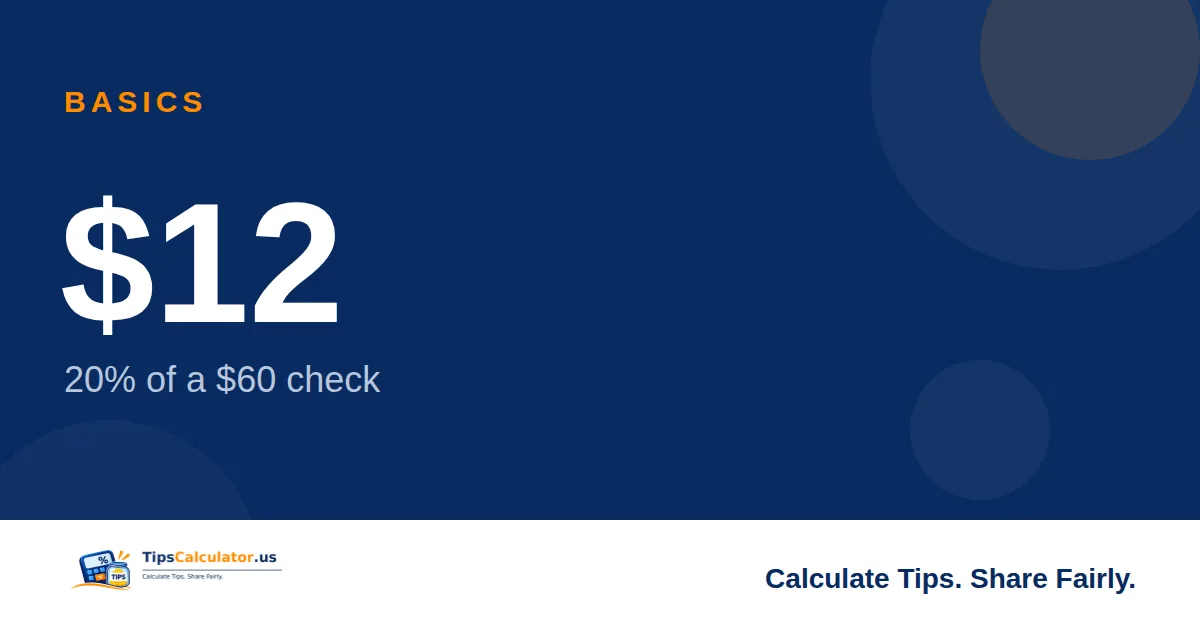
What is the formula to calculate a tip?
The formula is tip equals bill times percent. Write the percent as a decimal first: 20% becomes 0.20, 18% becomes 0.18, and 15% becomes 0.15. Multiply the bill by that decimal to get the tip, then add the tip to the bill for the total. That is the whole formula, and it works for every check.
| Bill Amount | 15% Tip | 18% Tip | 20% Tip | Total at 20% |
|---|---|---|---|---|
| $25 | $3.75 | $4.50 | $5.00 | $30 |
| $40 | $6.00 | $7.20 | $8.00 | $48 |
| $60 | $9.00 | $10.80 | $12.00 | $72 |
| $80 | $12.00 | $14.40 | $16.00 | $96 |
| $100 | $15.00 | $18.00 | $20.00 | $120 |
| $120 | $18.00 | $21.60 | $24.00 | $144 |
Tip amounts are figured on the bill before tax. Totals in the last column add a 20% tip only, with no tax added.
If you want the number without doing the math, the free tip calculator on the homepage works out the tip, the total, and the split in one tap. It takes seconds, and the breakdown shows every step.
When you are unsure what to tip, 20% is the safe choice. It fits good service at almost any sit-down restaurant, and it is the rate servers expect for good work. Save 15% for service that was only adequate.
How do you calculate a tip on a $60 check?
On a $60 check, a 15% tip is $9, an 18% tip is $10.80, and a 20% tip is $12. The totals are $69, $70.80, and $72. Round the 18% total to $71 and call it done. Pick the rate that matches the service, then add the tip to the check.
The math on a $60 check
Tip = $60 x 0.20 = $12.00
Total = $60 + $12 = $72
At 15%, the tip is $9 and the total is $69. At 18%, the tip is $10.80 and the total is $70.80. Split four ways at 20%, each person pays $18.
How do you calculate a tip when you split the bill?
Figure the tip on the full check first, then divide the total by the number of people. On a $60 check with a 20% tip, the total is $72, so four people pay $18 each. Never split the check first and tip each share, since rounding on small shares adds up to the wrong total.
Tip the full check first, then split the total. That order keeps every share exact, and the table can see the math in one line. If one person ordered far more than the rest, split by what each person ordered instead of splitting evenly.
If your phone is dead, the same answers come from three short mental tricks. See how to calculate a tip in your head for the 10% doubling trick and two more that work on any check.
For a percent that is not 15, 18, or 20%, the tip percentage calculator handles any custom rate and shows the per-person share too. Type the bill, type the percent, and the answer is ready.
When should you tip more or less than 20%?
Tip 20% for good service, 22 to 25% when the service stood out, and 15% when it was only adequate. Go above 20% for large parties, tricky orders, and staff who fixed a problem. Drop below 20% only when the service truly fell short, and tell the server or manager what went wrong.
- Tip 25% when the server handled a big group, a split check, or a guest with a long list of needs and still kept the table happy.
- Tip 15% when the service was slow or inattentive but the food arrived right and no one was rude.
- Work the tip from the subtotal before tax. On a $60 check with 8% tax, the gap between the two ways is under a dollar at 20%.
- Check for auto-gratuity before you add a tip. Large parties often have 18 to 20% added already, and tipping on top of it doubles the tip.
Check the check before you tip. If an 18 to 20% service charge is already printed on it, that charge is the tip. Add more only when the service earned more.
How do you calculate a tip on a bill with cents, like $47.83?
Work from the exact bill, then round the tip to the nearest cent. On a $47.83 check, a 20% tip is $9.57, an 18% tip is $8.61, and a 15% tip is $7.17. The totals are $57.40, $56.44, and $55.00. Round the bill first only when you want a fast estimate, not the exact tip.
Start with the decimal. Twenty percent is 0.20, so $47.83 times 0.20 is $9.566. The digit after the cents is 6, so the tip rounds up to $9.57. At 18%, $47.83 times 0.18 is $8.6094, which rounds to $8.61. At 15%, $47.83 times 0.15 is $7.1745, which rounds down to $7.17. Five or more rounds the cents up. Four or less rounds them down.
| Bill Amount | 15% Tip | 18% Tip | 20% Tip | Total at 20% |
|---|---|---|---|---|
| $47.83 | $7.17 | $8.61 | $9.57 | $57.40 |
| $83.50 | $12.53 | $15.03 | $16.70 | $100.20 |
| $126.40 | $18.96 | $22.75 | $25.28 | $151.68 |
Tips are figured on the bill before tax and rounded to the nearest cent. Totals add a 20% tip only, with no tax added.
Rounding the bill first gives a fast estimate, not the exact tip. Round $47.83 to $48 and 20% is $9.60, three cents above the exact $9.57. Round it to $45 and 20% is $9.00, 57 cents below exact. Round it to $50 and 20% is $10.00, 43 cents above exact. Round to the nearest dollar when you want the estimate close. Round to the nearest five dollars only when a rough number will do.
Pick one rounding move. Round the tip or round the total, not both. On the $47.83 check at 20%, the exact tip is $9.57 and the total is $57.40. Round the tip to $10 and the total becomes $57.83. Round the total to $58 instead and the tip becomes $10.17, about 21% of the check. With a card, exact cents cost nothing, so keep them. With cash, round the total to a whole dollar so no coins change hands.
Check an odd bill against the calculator when the cents stack up. Enter $47.83, pick the percent, and the free tip calculator shows the tip and the total at once. Compare its number with your hand math. If the two differ, recheck the decimal first.
What mistakes make a tip come out wrong?
The tip comes out wrong when the decimal slips, the tax gets tipped without a choice, or a printed gratuity gets tipped twice. Each mistake has one fix: check the decimal, tip the pre-tax subtotal, and read the check for a service charge before you add a tip. One short check catches all three.
The decimal slip is the easiest mistake to catch. Twenty percent is 0.20, not 0.02. On a $60 check, $60 times 0.02 is $1.20, while $60 times 0.20 is $12.00. On a $126.40 check, the slip gives $2.53 instead of $25.28. Catch it with one check: a 20% tip times five must equal the bill. Twelve dollars times five is $60, so $12 is right. One dollar and twenty cents times five is $6, so $1.20 is wrong.
Tipping the post-tax total by accident adds tax to the tip. On an $85 check with 8% tax, the tax is $6.80 and the post-tax total is $91.80. Twenty percent of $91.80 is $18.36, while 20% of the $85 subtotal is $17.00, a gap of $1.36. On a $200 check with 8% tax, the gap is $3.20: $43.20 on the post-tax $216, against $40.00 on the pre-tax $200. Tipping after tax is a choice, not an error, but make it on purpose. Read the subtotal line and tip that number.
The double tip happens when a printed gratuity gets tipped again. On a $200 check with an 18% automatic gratuity, $36 is already on the check. Add a 20% tip of $40 and the server gets $76, which is 38% of the check. If the service earned more than the printed amount, add only the extra. Want 25% on that $200 check? Twenty-five percent is $50, the printed gratuity is $36, so add $14 and stop. Read the check for a service charge before you write any tip.
Entering the tax twice inflates the total fast. Enter $129.60, which is $120 plus $9.60 tax, as the bill, then add 8% tax again, and the tax line becomes $10.37. The tip at 20% becomes $25.92, and the total reaches $165.89, which is $12.29 above the correct $153.60. Enter the pre-tax subtotal, add tax once with the "Add tax" option, and keep "Pre-tax bill" selected. The tip then stays on $120, where it belongs.
Splitting before tipping lets rounding errors stack. Work the tip on the full check, split the total, and check that the shares add back to the total. On a $56.44 total split three ways, each share is $18.81, and three shares add to $56.43, one cent short. Let one person pay $18.82 and the sum is exact. Add the shares back before anyone pays.
Frequently asked questions about calculating a tip
These are the questions people ask most when the check arrives, answered with the same formula used through this guide. The rates match the table above, and every answer shows the math so you can check it. If you want the number worked out for you, the calculator link in the first section does it in seconds.
What is the easiest way to calculate a 20% tip?
Move the decimal point one place to the left to find 10%, then double it. On a $60 check, 10% is $6, so 20% is $12. The same move works on any bill: $47 gives $4.70 at 10% and $9.40 at 20%. Round to the nearest dollar if you like round totals.
How do you calculate a 15% tip?
Find 10% first, then add half of that number. On a $60 check, 10% is $6, half of $6 is $3, and $6 plus $3 is $9. That $9 is the 15% tip, and the total is $69. The trick works on any check because 15% is 10% plus half of 10%.
Should you calculate the tip before or after tax?
Tip on the pre-tax subtotal. Tax goes to the state, not to your server, so the custom is to leave it out of the tip math. The gap is small: on a $60 check with 8% tax, a 20% tip is $12 before tax and $12.96 after tax, a difference of 96 cents. Both ways are accepted.
How do you calculate a tip for a group?
Add the tip to the full check first, then divide the total by the number of people. A $60 check with a 20% tip totals $72, so four people pay $18 each. If one person ordered far more than the rest, split by what each person ordered instead of splitting the total evenly.
How do you calculate a tip on a bill with cents?
Multiply the exact bill by the percent as a decimal, then round the tip to the nearest cent. On a $47.83 check, 20% is $9.57 and the total is $57.40. At 18%, the tip is $8.61 and the total is $56.44. Round the bill to the nearest dollar only for a fast estimate.
Sources and accuracy
Tipping rates on this page follow the standard US ranges used across this site. Every worked example on this page has been checked by hand. Bills vary, so use the percent and the formula, not a fixed dollar amount, when your check costs more or less than the examples here.
Tipping rates follow the standard US ranges.
No math at the table
Work out your tip in seconds
Enter the bill, pick 15, 18, or 20%, and see the tip, the total, and each person's share at once. The calculator works in any of five currencies, rounds the total when you ask it to, and shares the receipt on WhatsApp. No sign-up, no app, no math at the table.
